Jon Chait and Matt Yglesias are dumping on John McCain for being a shameless flip-flopper. Which he is.
I think the comparisons to Barack Obama's relative consistency, however, are a little bit unfair, since Obama is currently winning. Right now there's not a lot of pressure on Obama to change his positions, but it's hard to say what kind of moves he'd be making if his situation was as desperate as McCain's.
Showing posts with label The New Republic. Show all posts
Showing posts with label The New Republic. Show all posts
Sunday, July 27, 2008

Sunday, July 06, 2008
Predictions - Chait - 9/18/2008
Via Matt Yglesias, Jon Chait makes the following prediction:
Expiration Date: September 18, 2008
Anway, let me now go on the record to say that another McCain staff shake-up is, if not inevitable, very likely. McCain's staff is just too factionalized to remain stable unless McCain is consistently winning. And Schmidt is a Bush 2004 veteran who lacks the deep emotional ties to the candiate that other McCainiacs have. I predict that at some point, probably just before or just after the convention, there will be a move to "Let McCain be McCain," and new boss Steve Schmidt will be replaced with either John Weaver or Mike Murphy, to try to recreate the magic of the 2000 campaign.Let's say that "just after the convention" could mean up to two weeks later.
Expiration Date: September 18, 2008
Thursday, May 03, 2007
The New Left in the kitchen, with the candlestick
 Jon Chait’s insightful but often infuriating article in TNR on the subject of Netroots has lead to a lot of great discussion on the blogs but one thing that struck me was the difference between how Chait sees Netroots and how Netroots see themselves. Both understand Netroots as a popular movement. But Chait – representing the TNR, DLC, Mickey Kaus wing of liberalism – sees popular movements in general in a very skeptical light. I think this is because for those liberals, the only popular movements they have ever known are the right-wing machine – not famous for its ability to reason logically – and the New Left – which featured the wafting scent of patchouli and ineffectual protest march thuggery.
Most bloggers don’t think of the New Left much, but to me, the New Left was a response to the failures of the old New Deal coalition and the paradigms that went with it. Where the New Deal coalition depended on passively accepting racism, the New Left sought equality for all oppressed people (not just blacks, but women, Native Americans and more). Where the New Deal paradigm viewed all foreign policy issues as Communists vs. Capitalists the New Left recognized the neglected values of democracy and self-determination. Where the New Deal descended into political corruption and backroom deals the New Left saw sought change by confronting the system from the outside.
Now, as a project aimed at fixing the shortcomings of the New Deal the New Left had it’s hits and misses. Its crowning achievement was the civil rights movement and helping to end the Vietnam war, but outside those victories the movement was pretty ineffectual and – like most movements whose paradigms no longer apply – its legacy was handed over to those too ideological and too closed-minded to think their way out of it. That’s the same process we’re seeing now in the right – where everyday intelligent conservative thinkers are cashing in their chips and leaving conservative thought to the Rush Limbaugh’s and Ann Coulter’s of the world.
So, having seen two popular movements sink into buffoonery before their eyes, you can forgive people like Chait for being cautious about accepting Netroots. However, I think another belief of theirs further heighten this caution: Chait, like many Neolibs, think the New Left killed liberalism. I’ve written too much already but let me just state that I think liberalisms fall in the 70’s and 80’s was the result of the old paradigms of the New Deal becoming irrelevant or unsustainable. The New Left didn’t kill the New Deal. The New Deal died of natural causes.
The danger of being skeptical of popular movements is that it will cripple our ability to motivate voters and defend our values. The New Deal lead to tax-and-spend excesses but it also passed Social Security and Medicare. The New Left lead to marijuana infused love-ins and Che posters but it also realized the dream of African American suffrage. What will Netroots give us before it decent into blogofascism is complete?
Monday, January 15, 2007
Dawkins, Nagel, and The God Delusion
I just finished reading Richard Dawkins's The God Delusion, and I liked it very much. It's a book trying to popularize certain biological and philosophical ideas, and having studied both biology and philosophy in college, there was much I found unoriginal and a little that I felt was poorly treated. Nonetheless, on the whole the book is very interesting, not least for it's hard-line stance against religion. The central project of the book is well captured by the title of the fourth chapter: "Why There Almost Certainly Is No God". And Dawkins makes a point of being as blunt as possible about his anti-theism. Raising the young to be religious is child abuse, he thinks, and he fails to see why theology ought to be viewed as a field of study at all.
As my acquaintances may guess, I am broadly sympathetic to these sorts of ideas. I'll come right out and say that I think the world would be a better place, on balance, without religion, and I too resent the privileged status granted to religious beliefs such that they are considered to be above criticism. Believing something to be true in the absence of supporting evidence is, to put it mildly, silly, and when the evidence is in opposition to your belief, well, then, you're just being willfully stupid.
When it comes to matters of faith, though, a great many people are willfully stupid, and a great many of the criticisms of The God Delusion are predictably unintelligent. There is the fair charge that the book is poorly edited and contemptuous, but none of that speaks to the merits of its argumentation. I'd like to have read a clearer, more disciplined book, but that sort of quibble is a distraction. It's also true that Dawkins could have been more polite in his delivery but, again, the most this gets you as a criticism is that the book is likely to offend people it could otherwise persuade.
To date, I've read only one insightful criticism of this book, and it comes from Thomas Nagel. I'd known that Nagel had written a review , but prior to reading the book I didn't see why I should particularly care what he had to say about it since it wasn't obviously his field. Dawkins, though, makes some dismissive comments about moral absolutism and ontological dualism. After reading the book, I can see why Nagel would be interested, since Nagel is among the world's foremost advocates of both moral absolutism and ontological dualism. And besides, Nagel's a genuinely brilliant guy - a fact I can testify to not just as a result of reading his work but also from personal experience - so, I signed up for a trial subscription to the otherwise-lame New Republic just to read what he had to say.
Nagel's objection boils down to this:
Now, I think Nagel is right that Dawkins is too dismissive of dualism in general, probably because his exposure to philosophy is limited. You can file a similar complaint against Dawkins's contempt of moral absolutism, best captured by this bit from pg. 232:
One is forced to conclude that Dawkins isn't actually very familiar with the ins-and-outs of contemporary philosophy, since he seems oblivious to the widely-respected arguments for both ontological dualism and ethical absolutism. In both cases he just assumes - without any evident reason - that the position he disfavors is necessarily bound up with religion, and must therefore be summarily tossed out.
Plainly put, Dawkins is wrong to reject dualism and absolutism on the basis of the arguments he offers. At the same time, those technical philosophical criticisms have almost no practical impact on the arguments of the book. One need not reject ontological dualism to point out that religious people ascribe all sorts of ridiculous characteristics to the non-physical world and tend to assume that if non-physical phenomena exist, they must be the sort of phenomena that are described in, for instance, the Bible. Similarly, one need not reject moral absolutism to acknowledge that religious groups tend to come up with really lousy moral absolutes.
In other words, Dawkins assumes in multiple instances that when the content of religious beliefs is absurd, the underlying ethics or metaphysics must be equally absurd. That's a baby-with-the-bathwater mistake, and Dawkins of all people probably has friends who could have helped him clarify his thinking. Instead, he gets the philosophy wrong even though it's got no significance to his central thesis: namely, that we'd do well to get rid of religion altogether.
Update: Because Tom asked, and because I felt like this post wasn't quite long enough, I thought I'd expand on my thoughts on dualism a little bit.
I personally don't know that I subscribe to dualism. But I don't think I'm really committed to monism, either. My issue with Dawkins is that he just acts like dualism is obviously wrong, but in fact that is one of the central and most contentious questions in contemporary metaphysics.
I think dualism's got problems - most notably, a dualist has got to give some account of how it is that an essentially non-physical thing can interact causally with a physical thing (without running into conservation of energy problems, no less!) But dualism also has some very powerful arguments going for it.
The gist of the problem was formulated with force by Nagel, in that "Bat" article I linked to.
Reducing the mind down to physical facts about the body isn't like, say, reducing proteins down to individual amino acids, he thinks, because mental phenomena are necessarily subjective, while the physicalist project is aimed at moving toward ever-increasing objectivity. I can imagine, at best, what it would be like for me to be a bat, but no amount of physical knowledge could possibly let me know what it's like for the bat. This isn't a problem about being able to reproduce neurological states; it's a problem about being able to actually occupy a point of view that's not your own.
I think Nagel identifies a very real problem here, but Frank Jackson probably did it more clearly in "What Mary Didn't Know", the central argument of which is this:
Mary is a girl who is locked up in a black and white room without windows, where she is taught every physical fact about the world (using, of course, only black and white materials.) If it is actually possible to explain everything in the world in terms of physical facts, Mary knows everything there is to know.
Presumably, though, if Mary is then let out of the room, she will learn something new: namely, what it is like to see, for instance, red.
The underlying concern in both cases is that mental phenomena seem to have these subjective properties - "qualia", in the jargon - that you just can't get at with any quantity of physical knowledge. It's difficult to see how any set of physical facts could possibly lead to knowledge about what a mental phenomenon is like.
Of course, the way that philosophy works is that a lot of very smart people - Dawkins's buddy Daniel Dennett, for instance - have come up with really brilliant reasons why we shouldn't think that Mary learns anything new at all when she leaves her room. But it's not like the case has been closed, and my only real problem was with Dawkins acting like it was.
For my own part, I have physicalist sympathies, and I get the impression that monism generally is on the rise these days. But I am by no means confident that I could ever know what being a bat is like for a bat, and I think that's a real dilemma.
As my acquaintances may guess, I am broadly sympathetic to these sorts of ideas. I'll come right out and say that I think the world would be a better place, on balance, without religion, and I too resent the privileged status granted to religious beliefs such that they are considered to be above criticism. Believing something to be true in the absence of supporting evidence is, to put it mildly, silly, and when the evidence is in opposition to your belief, well, then, you're just being willfully stupid.
When it comes to matters of faith, though, a great many people are willfully stupid, and a great many of the criticisms of The God Delusion are predictably unintelligent. There is the fair charge that the book is poorly edited and contemptuous, but none of that speaks to the merits of its argumentation. I'd like to have read a clearer, more disciplined book, but that sort of quibble is a distraction. It's also true that Dawkins could have been more polite in his delivery but, again, the most this gets you as a criticism is that the book is likely to offend people it could otherwise persuade.
To date, I've read only one insightful criticism of this book, and it comes from Thomas Nagel. I'd known that Nagel had written a review , but prior to reading the book I didn't see why I should particularly care what he had to say about it since it wasn't obviously his field. Dawkins, though, makes some dismissive comments about moral absolutism and ontological dualism. After reading the book, I can see why Nagel would be interested, since Nagel is among the world's foremost advocates of both moral absolutism and ontological dualism. And besides, Nagel's a genuinely brilliant guy - a fact I can testify to not just as a result of reading his work but also from personal experience - so, I signed up for a trial subscription to the otherwise-lame New Republic just to read what he had to say.
Nagel's objection boils down to this:
The fear of religion leads too many scientifically minded atheists to cling to a defensive, world-flattening reductionism. Dawkins, like many of his contemporaries, is hobbled by the assumption that the only alternative to religion is to insist that the ultimate explanation of everything must lie in particle physics, string theory, or whatever purely extensional laws govern the elements of which the material world is composed.In other words, Dawkins has succumbed to the temptation to think that everything that exists has to be explained exclusively and ultimately in physical terms. Initially, Nagel dismissively refers to this as "amateur philosophy". Eventually he concedes in an off-hand way that there are actually a lot of questions left unanswered by "[a]ny anti-reductionist view", but the gist of the complaint seems to be that if Dawkins had just read "What is it Like to be a Bat?", his book would be very different (and, presumably, better.)
This reductionist dream is nourished by the extraordinary success of the physical sciences in our time, not least in their recent application to the understanding of life through molecular biology. It is natural to try to take any successful intellectual method as far as it will go. Yet the impulse to find an explanation of everything in physics has over the last fifty years gotten out of control. The concepts of physical science provide a very special, and partial, description of the world that experience reveals to us. It is the world with all subjective consciousness, sensory appearances, thought, value, purpose, and will left out. What remains is the mathematically describable order of things and events in space and time.
Now, I think Nagel is right that Dawkins is too dismissive of dualism in general, probably because his exposure to philosophy is limited. You can file a similar complaint against Dawkins's contempt of moral absolutism, best captured by this bit from pg. 232:
Moral philosophers are the professionals when it comes to thinking about right and wrong. As Robert Hinde succinctly put it, they agree that 'moral precepts, while not necessarily constructed by reason, should be defensible by reason'. They classify themselves in many ways, but in modern terminology the major divide is between 'deontologists' (such as Kant) and 'consequentialists' (including 'utilitarians' such as Jeremy Bentham, 1748-1832). Deontology is a fancy name for the belief that morality consists in the obeying of rules. It is literally the science of duty, from the Greek for 'that which is binding'. Deontology is not quite the same thing as moral absolutism, but for most purposes in a book about religion there is no need to dwell on the distinction. Absolutists believe there are absolutes of right and wrong, imperatives whose rightness makes no reference to their consequences. Consequentialists more pragmatically hold that the morality of an action should be judged by its consequences.Since Dawkins himself had pointed out only a few pages earlier that there are very plausible arguments that Kant was himself an atheist, it's not clear why he now dismisses deontologists out of hand as religious nuts. Certainly today there are no shortage of non-religious deontologists among the ranks of those moral philosophers who "are the professionals when it comes to thinking about right and wrong." (Nagel is one, as a matter of fact.)
..
Not all absolutism is derived from religion. Nevertheless, it is pretty hard to defend absolutist morals on grounds other than religious ones.
One is forced to conclude that Dawkins isn't actually very familiar with the ins-and-outs of contemporary philosophy, since he seems oblivious to the widely-respected arguments for both ontological dualism and ethical absolutism. In both cases he just assumes - without any evident reason - that the position he disfavors is necessarily bound up with religion, and must therefore be summarily tossed out.
Plainly put, Dawkins is wrong to reject dualism and absolutism on the basis of the arguments he offers. At the same time, those technical philosophical criticisms have almost no practical impact on the arguments of the book. One need not reject ontological dualism to point out that religious people ascribe all sorts of ridiculous characteristics to the non-physical world and tend to assume that if non-physical phenomena exist, they must be the sort of phenomena that are described in, for instance, the Bible. Similarly, one need not reject moral absolutism to acknowledge that religious groups tend to come up with really lousy moral absolutes.
In other words, Dawkins assumes in multiple instances that when the content of religious beliefs is absurd, the underlying ethics or metaphysics must be equally absurd. That's a baby-with-the-bathwater mistake, and Dawkins of all people probably has friends who could have helped him clarify his thinking. Instead, he gets the philosophy wrong even though it's got no significance to his central thesis: namely, that we'd do well to get rid of religion altogether.
Update: Because Tom asked, and because I felt like this post wasn't quite long enough, I thought I'd expand on my thoughts on dualism a little bit.
I personally don't know that I subscribe to dualism. But I don't think I'm really committed to monism, either. My issue with Dawkins is that he just acts like dualism is obviously wrong, but in fact that is one of the central and most contentious questions in contemporary metaphysics.
I think dualism's got problems - most notably, a dualist has got to give some account of how it is that an essentially non-physical thing can interact causally with a physical thing (without running into conservation of energy problems, no less!) But dualism also has some very powerful arguments going for it.
The gist of the problem was formulated with force by Nagel, in that "Bat" article I linked to.
I have said that the essence of the belief that bats have experience is that there is something that it is like to be a bat. Now we know that most bats (the microchiroptera, to be precise) perceive the external world primarily by sonar, or echolocation, detecting the reflections, from objects within range, of their own rapid, subtly modulated, high-frequency shrieks. Their brains are designed to correlate the outgoing impulses with the subsequent echoes, and the information thus acquired enables bats to make precise discriminations of distance, size, shape, motion, and texture comparable to those we make by vision. But bat sonar, though clearly a form of perception, is not similar in its operation to any sense that we possess, and there is no reason to suppose that it is subjectively like anything we can experience or imagine. This appears to create difficulties for the notion of what it is like to be a bat. We must consider whether any method will permit us to extrapolate to the inner life of the bat from our own case, and if not, what alternative methods there may be for understanding the notion.
Our own experience provides the basic material for our imagination, whose range is therefore limited. It will not help to try to imagine that one has webbing on one's arms, which enables one to fly around at dusk and dawn catching insects in one's mouth; that one has very poor vision, and perceives the surrounding world by a system of reflected high-frequency sound signals; and that one spends the day hanging upside down by one's feet in an attic. In so far as I can imagine this (which is not very far), it tells me only what it would be like for me to behave as a bat behaves. But that is not the question. I want to know what it is like for a bat to be a bat. Yet if I try to imagine this, I am restricted to the resources of my own mind, and those resources are inadequate to the task. I cannot perform it either by imagining additions to my present experience, or by imagining segments gradually subtracted from it, or by imagining some combination of additions, subtractions, and modifications.
...
It is difficult to understand what could be meant by the objective character of an experience, apart from the particular point of view from which its subject apprehends it. After all, what would be left of what it was like to be a bat if one removed the viewpoint of the bat?
Reducing the mind down to physical facts about the body isn't like, say, reducing proteins down to individual amino acids, he thinks, because mental phenomena are necessarily subjective, while the physicalist project is aimed at moving toward ever-increasing objectivity. I can imagine, at best, what it would be like for me to be a bat, but no amount of physical knowledge could possibly let me know what it's like for the bat. This isn't a problem about being able to reproduce neurological states; it's a problem about being able to actually occupy a point of view that's not your own.
I think Nagel identifies a very real problem here, but Frank Jackson probably did it more clearly in "What Mary Didn't Know", the central argument of which is this:
Mary is a girl who is locked up in a black and white room without windows, where she is taught every physical fact about the world (using, of course, only black and white materials.) If it is actually possible to explain everything in the world in terms of physical facts, Mary knows everything there is to know.
Presumably, though, if Mary is then let out of the room, she will learn something new: namely, what it is like to see, for instance, red.
The underlying concern in both cases is that mental phenomena seem to have these subjective properties - "qualia", in the jargon - that you just can't get at with any quantity of physical knowledge. It's difficult to see how any set of physical facts could possibly lead to knowledge about what a mental phenomenon is like.
Of course, the way that philosophy works is that a lot of very smart people - Dawkins's buddy Daniel Dennett, for instance - have come up with really brilliant reasons why we shouldn't think that Mary learns anything new at all when she leaves her room. But it's not like the case has been closed, and my only real problem was with Dawkins acting like it was.
For my own part, I have physicalist sympathies, and I get the impression that monism generally is on the rise these days. But I am by no means confident that I could ever know what being a bat is like for a bat, and I think that's a real dilemma.
Friday, December 22, 2006
The most contrarian position is the one which is clearly wrong
Shorter Peter Beinart:
The "reality based" liberals who oppose the war are the real neocons.It would be ten times funnier if the joint advocacy of the Iraq war by Peter Beinart's TNR and the neocons didn't lead to thousands of American and Iraqi deaths.
Tuesday, December 19, 2006
TNR Run down
I might grow old and die before finishing this review of TNR, so I'll be quicker about it:
Divide Iraq, Peter W. Galbraith
Wrong. The regions of Iraq are not heterogeneous. Dividing Iraq would take one state where minorities aren’t safe and turn them into a bunch of countries where different minorities aren’t safe. See this for more. Much of Galbraith’s arguments are refuted in the next article:
Keep It Whole, Reza Aslan
Right on. The best point he makes is that oil is not evenly distributed in Iraq. Any division of Iraq would necessarily founder on that issue.
Force Everyone To The Table, Anne-Marie Slaughter
She says “throw a big peace conference and if it doesn’t work go home”. Fine. I don’t think a conference would work but I’m happy to try one if that’s what it takes to get some people to support withdrawal. I should point out that not talking to countries like Syria and Iran are part of official Bush doctrine and he shows no sign of changing that.
Deal With The Sunnis, Larry Diamond
He wants to cut a deal with the Sunni insurgents to get them on our side. He says “ensure that the central government will control the oil and not the Shia regions that have the oil”. Of course the problem is “we” can’t cut any kind of deal. The US doesn’t own the oil-fields in Iraq. The Iraqi government does. And it’s run by Maliki and his Sadr’s chums. So the question is how do we get Maliki to hand over the oil? I don’t know. And how do we get Sadr’s voting block in parliament to go along with it? I don’t know that either. And why should the Sunnis be happy knowing that the central government will control the oil when they know they will always be outnumbered by the Shia there? Mr. Diamond doesn’t know either or else he’s not very good at writing essays.
To be continued…
Wednesday, December 13, 2006
TNR Review: On Robert Kagan
Next up in my review of TNR is the article by NeoCon Robert Kagan. He wants to send more troops to Iraq.
The truth is that we have vast militias in Iraq that are politically invulnerable because the people who run them are in the Iraqi government. Those militias are fighting each other because each honestly thinks they can prevail at least within their sphere of influence. Kagan's plan only makes sense if you already believe that a positive resolution to the Iraq conflict is possible. If, like me, you disagree, Kagan's plan just looks like a way of getting a whole lot more American soldiers killed.
Update: Spencer Ackerman (formerly of TNR) responds to Kagan's lunacy in more depth.
The first priority ought to be to secure Baghdad, which U.S. policy has disastrously failed to do. To accomplish this, the United States should send an additional 50,000 troops at least, the bulk of them to Baghdad so that the city can be made safe for its inhabitants, but without drawing forces from elsewhere in the country. Once Baghdad is secure, U.S. and Iraqi forces could extend their operations into Sunni-controlled areas. This will take time. But a secure Baghdad would provide at least one pillar on which any eventual political settlement could be based.I want to keep my TNR bashing to minimum but I should point out that not only does this sound like it was cribbed from The Weekly Standard – it actually was. But lets deal with the substance instead of guilt by association. Do we actually have 50,000 extra troops to send to Iraq? Well the Pentagon says no:
Some claim that we don’t have 50,000 troops to send to Iraq. In fact, the troops are available. Sending additional forces to Iraq means lengthening troop rotations, as the United States has done in previous major conflicts. Sustaining such an increased deployment, however, will require a substantial increase in the overall size of the Army and Marines. This increase, which does not require a draft but does require money, is necessary regardless of what we do in Iraq. It is stunning that this administration has attempted to fight two wars and has envisioned other possible interventions with a force clearly inadequate.
The US army is being stretched, by its deployment in Iraq and Afghanistan, into a "thin green line" in danger of breaking before the insurgents are defeated, claims a report commissioned by the Pentagon.So, at best we could surge forces for a little while. Ok fine. Kagan's whole point is that no political solution can arise until there is security so we should focus on that first. The problem is that - like the underpants gnomes - Kagan is pretty shady on what exactly the political solution is or how it will be reached.
Andrew Krepinevich, a former army officer who wrote the report, said that the army could not sustain the current pace of deployments - which was likely in the end to discourage recruitment.
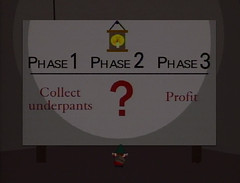
The truth is that we have vast militias in Iraq that are politically invulnerable because the people who run them are in the Iraqi government. Those militias are fighting each other because each honestly thinks they can prevail at least within their sphere of influence. Kagan's plan only makes sense if you already believe that a positive resolution to the Iraq conflict is possible. If, like me, you disagree, Kagan's plan just looks like a way of getting a whole lot more American soldiers killed.
Update: Spencer Ackerman (formerly of TNR) responds to Kagan's lunacy in more depth.
Wednesday, December 06, 2006
TNR review: the continuation
Richard Clarke and David Rieff bother have article in this issue that call for withdrawal. Here’s Clarke:
This “support the war or support pulling out in half and hour” paradigm seems to be so strong at TNR that when David Rieff - a regular contributor – penned his piece he couldn’t help but fulfill some of the worst instincts of the anti-war forces:
We can pursue our core interests in Iraq--ensuring that the country does not become a terrorist base and that it does not destabilize the rest of the region--without a large occupying force. To do this, we should announce our intention to reduce U.S. forces in Iraq beginning in December and concluding with the withdrawal of all major ground combat units within 18 months; declare that the United States seeks no permanent military bases in Iraq; gain permission from Kuwait to station additional combat units there to create an "over the horizon" capability to deal with terrorists in Iraq; accelerate the training and equipping of the Iraqi army with embedded Special Forces; work with our regional allies to create an enhanced covert action capacity to combat Iraq-based terrorism; speed up U.S. reconstruction efforts; and convene a regional process to guarantee the stability of Iraq, inviting Iran, Syria, Jordan, Turkey, and the Gulf countries to join.It’s telling that they had to hire an outsider to pen this reasonable piece. Though it’s not an opinion often expressed in TNR supporting troop withdrawals doesn’t mean supporting isolation.
This “support the war or support pulling out in half and hour” paradigm seems to be so strong at TNR that when David Rieff - a regular contributor – penned his piece he couldn’t help but fulfill some of the worst instincts of the anti-war forces:
At the Democratic convention in Chicago in 1968, while his policemen were beating up the demonstrators along the Loop and in Lincoln Park, Mayor Richard Daley apparently told Lyndon Johnson that it was time to pull the troops out of Vietnam, once and for all. "How am I to do this?" Johnson asked pleadingly. To which Daley is said to have replied: "You put the fucking troops on the fucking planes and you get them out of there!"Now it could be that Rieff is just being hyperbolic here. He could just mean “get them out quickly in the safest way possible”. As far as I know doing that would take somewhere around a year to – as Clarke said – 18 months. Still I can’t help but take him seriously when he makes the unserious suggestion of just putting the soldiers onto planes as fast a possible. Not only would this be logistically difficult for our troops but it wouldn't give Iraqis any chance to prepare for the sea change it would bring. It seems that TNR offers an equal opportunity to read both unserious pro-war arguments and unserious anti-war ones.
Apart from protecting the Kurds, whose possible acquisition of statehood may be the only good news of this whole dreadful adventure--America's Sicilian Expedition, I fear--there is no longer anything we can do. And the Kurds can probably look after themselves anyway. It is time to put the fucking troops on the fucking planes. Now! Before any more of our children die for their country's hubris.
Tom’s rating: 10/10 and 6/10
Probability of being instituted: 5/10 and 5/10
Pony plan rating: N/A and N/A
Update: Spencer Ackerman, formerly of TNR explains that being for withdrawal is not good for your career at TNR.How many times, guys? How many times did you intimate to me that I was in league with the terrorists when I told you to get out of Iraq? Hey, Leon, do you remember the editorial meeting after the Blackwater lynching in late March 2004? That was the first time I said I thought the war was unwinnable, and that was the first time you told me ("joking," of course) that I was fired. Yeah, it was funny the first time, I guess, but after the next hundred, the joke gets kind of old.Spencer Ackerman was a writer at TNR whom the editors once thought so well-versed in Iraq that they let him write a blog dedicated to it.
Wednesday, November 29, 2006
Reviewing TNR: George Packer
In his heart-breaking piece "Save Whomever We Can" George Packer demonstrates his understanding of just how horrible the situation in Iraq has become. He doesn't offer a any Pony Plan's to accomplish impossible goals but he does describe one goal which is attainable in withdrawal:
I'm with Kevin Drumm, the only question is whether this plan is practical. I don't really see why not. Surely getting them out of Iraq won't be a problem. Mostly it'll be a question of security. That we'd have to take on the risk of issuing visas to terrorists to make the best out of a bad situation is yet another grim irony for those who saw invading Iraq as a way securing the US....Those Iraqis who have had anything to do with the occupation and its promises of democracy will be among the first to be killed: the translators, the government officials, the embassy employees, the journalists, the organizers of women's and human rights groups. As it is, they are being killed one by one. (I personally know at least half a dozen of them who have been murdered.) Without the protection of the Green Zone, U.S. bases, or the inhibiting effect on the Sunni and Shia militias of 150,000 U.S. troops, they will be killed in much greater numbers. To me, the relevant historical analogy is not the helicopters taking off from the roof of the U.S. Embassy in Saigon, leaving thousands of Vietnamese to the reeducation camps. It is the systematic slaughter by the Khmer Rouge of every Cambodian who appeared to have had anything to do with the West.
...We should start issuing visas in Baghdad, as well as in the regional embassies in Mosul, Kirkuk, Hilla, and Basra. We should issue them liberally, which means that we should vastly increase our quota for Iraqi refugees. (Last year, it was fewer than 200.) We should prepare contingency plans for massive airlifts and ground escorts. We should be ready for desperate and angry crowds at the gates of the Green Zone and U.S. bases. We should not allow wishful thinking to put off these decisions until it's too late. We should not compound our betrayals of Iraqis who put their hopes in our hands.
Tom’s rating: 10/10
Probability of being instituted: 5/10
Pony plan rating: 0/10
Monday, November 27, 2006
A review of the latest issue of TNR
TNR recently put out an issue about Iraq and Aaron said he though I should read it. To do him one better I'm going to read it and comment one article at a time. I'll start with Peter Bienart's piece:
At this late date, the United States has only one card left to play in Iraq: the threat to leave immediately. Except for Sadr, virtually no one in Iraq's political class wants that to happen. We must wield that threat as dramatically as possible, and, if Iraq's leaders don't respond, leave as fast as we humanly can.The vehicle for this last-ditch effort would be a conference of Iraq's leaders and Iraq's neighbors (along with Russia, which has more leverage over Iran and Syria than we do). The goal would be revising Iraq's constitution to guarantee Sunnis a generous share of the nation's oil wealth (which is practically Iraq's only source of wealth). This is precisely the guarantee that Shia leaders refused to offer after they won the January 2005 elections. And it is the only way to convince Sunnis to accept a new Shia- and Kurd-dominated Iraq. To give Shia leaders an incentive to agree, the United States should offer the biggest carrot possible: not just a continued U.S. troop presence, but a temporary troop increase and a dramatically larger, World Bank-overseen development effort. We should also offer the biggest possible stick: If the conference ends in failure, the United States should begin its full withdrawal that very day. (We'd leave some troops in the neighborhood for operations against Al Qaeda.)
My response: Bienart’s plan might have been a good one a year or two ago. Back then you could argue that Sunnis really were just upset about oil wealth. Now however we’re dealing with a civil war. Sunnis are fighting because they rightly fear for their lives.
But no matter, let’s say Maliki concedes – losing all support from his base in the process – Sadr won’t and he controls the most powerful militia. The militias in turn have the support of regular Iraqis because they’re providing the security and basic services which the central government and US troops couldn’t. So the grand bargain doesn’t disband the major Shiite militias and of course the Sunnis can’t be expected to disband theirs until that happens (have to defend themselves!). The only thing the plan does is destroy Maliki’s political career. And if they do accept the bargain our reluctant soldiers are then stuck dying… for what exactly? Train Iraqi soldiers who will never confront the Iraqi militias because the political leadership depends on those militias? I’m sorry but that’s not worth 70+ dead Americans a month.
Tom’s rating: 5/10
Probability of being instituted: 3/10
Pony plan rating*: 9/10
*See Matt Yglesias:
Anyone who defends Bush's strategy is going to wind up looking bad, because after continuing to fail for a while it will be abandonned in favor of withdrawal. Anyone who advocates withdrawal is going to wind up looking bad, because eventually it will be implemented and bad stuff will happen down the road. Consequently, what you need to go is suggest a pony hunt in some territory where you're sure the administration won't go looking (calls for a regional conference are the center-left version of this) that way when the stay-the-course-until-eventually-you-leave cycle plays out, you get to claim that if only they'd followed my advice the war would have been won. Meanwhile, blame for defeat will be located primarily not on George W. Bush, but on the stab-in-the-back crowd on the left who made it politically impossible for Bush to find the pony.
Monday, September 11, 2006
The long war against TNR's reputation
The global struggle against blogofascism steps up a notch with the creation of a blog specifically for TNR owner and crazy man Martin Peretz:
Let me concede: I am a friend of Scooter Libby. But I do not like his boss. And I do not like his boss's wife. I know this gets me no credit with the all-or-nothing crowd. Still, I like Scooter, who is quite brilliant, very honest, and brave. Also funny. I've contributed to The Libby Legal Defense Fund and have joined the fund's advisory committee, which is not large because in Washington old pals dessert when even their college roommate gets into trouble. In a time when self-styled civil libertarians are giving money to defend Muslim terrorists, I am happy to help defend an American patriot, some of whose politics I do not share and some of whose politics I do, from a cynical onslaught of the special prosecutor who put journalists into jail for not telling him what he already knew.I'm sure it warms the hearts of TNR readers to know that their money is going to help defend Libby against 5 counts of false statements, perjury, and obstruction of justice rather than, say, reelecting Democrats. But then, we shouldn't forget, Peretz - the man who signs the paychecks of everyone at TNR - hasn't quite decided whether he prefers to have Dems take over the house or senate this year:
HH: Do you want the Democrats to win majorities in the House or the Senate, Martin Peretz?
MP: I'm...I'm appalled by some of the people who would become head of Congressional committees.
HH: Is that a no?
MP: Uh, but I'm also appalled by some of the shenanigans...
HH: But is that...I've got five seconds. Is that a no, Martin Peretz?
MP: It's a cowardly refusal to answer.
HH: (laughing) Okay. We'll carry it on, later. Martin Peretz, thanks
We must accept that either 1. Editorial decisions at TNR - decisions like who gets a blog - are not very well insulated from the whims of those backing the magazine monetarily or 2. Editorial judgments at TNR are poor. Or I suppose both can be true.
Either way it does not speak well to the magazines integrity or savvy.
Saturday, September 02, 2006
Update: Don't wonder any longer
As an update to my earlier post: Those wondering why TNR's Lee Siegal still has a job need to wonder no longer. The writer who famously called The Daily Kos a fascist has been kicked to the curb:
Update: Ezra Klien adds more.
Update: You really have to read this to believe it.
I suppose TNR isn't all bad.After an investigation, The New Republic has determined that the comments in our Talkback section defending Lee Siegel's articles and blog under the username "sprezzatura" were produced with Siegel's participation. We deeply regret misleading our readers. Lee Siegel's blog will no longer be published by TNR, and he has been suspended from writing for the magazine.
Franklin Foer
Editor, The New Republic
Update: Ezra Klien adds more.
Update: You really have to read this to believe it.
Thursday, August 10, 2006
"It's a cowardly refusal to answer."
Ok ok. I don't want to bash The New Republic all the time but I just want to point out that we should just stop referring to it as a liberal magazine. It's not. That's not necessarily a bad thing. You can be a resepectable non-ideolgical mag or even a respected neo-con-for-libs mag. But in addition to it's history of hiring, publishing, and fostering plain-old vanilla conservatives, there's this from the co-owner and Editor-in-Chief, Martin Peretz:
HH: Do you want the Democrats to win majorities in the House or the Senate, Martin Peretz?
MP: I'm...I'm appalled by some of the people who would become head of Congressional committees.
HH: Is that a no?
MP: Uh, but I'm also appalled by some of the shenanigans...
HH: But is that...I've got five seconds. Is that a no, Martin Peretz?
MP: It's a cowardly refusal to answer.
HH: (laughing) Okay. We'll carry it on, later. Martin Peretz, thanks.
Ok, when you can't make up your mind over who he wants to win congress, you aren't a liberal. I know that Martin Peretz is a crazy who only gets printed becuase he bought the magazine, but seriously how can people get worked up over the monetary ties of a voluntary advertising ring run by
Subscribe to:
Posts (Atom)